If you're running a business in a rural area or an underserved community, you probably know the frustration of unreliable internet. Laying fiber cables to every location can be expensive, and often takes years. Meanwhile, your business needs connectivity right now.
TL;DR
- Fixed wireless internet is a business broadband service that delivers connectivity over radio signals from a transmission tower to a receiver at your location, with no trenching or buried cable required.
- Business-class fixed wireless reaches download speeds up to 500 Mbps, uploads of 50 to 100 Mbps, and latency of 10 to 30 milliseconds, rivaling fiber in modern 5G and mmWave deployments.
- Fixed wireless suits rural or underserved sites, temporary and remote locations, businesses that need internet quickly, and companies wanting a backup connection for redundancy.
- Line-of-sight obstructions and heavy weather can weaken the signal, but a dedicated, well-engineered link within 5 to 10 miles of the tower keeps performance reliable for business use.
The good news is that fixed wireless internet is changing that conversation. But what is fixed wireless internet, and how does fixed wireless access (FWA) work for modern businesses? In this guide, we’ll break it down – covering FWA meaning, how the technology works, and when it might be the right fit for your business.
What Is Fixed Wireless Internet?
Fixed wireless internet is a type of business internet that delivers connectivity using radio signals instead of cables. Unlike mobile wireless, fixed wireless provides a dedicated, stationary connection between two fixed points – typically a base station (transmitter) and a receiver installed at your business location.
The technology uses what's called a line-of-sight connection, meaning the receiver at your location needs a relatively clear path to the transmission tower. In most cases, this works well for businesses in rural areas, suburban locations, or anywhere that's been underserved by traditional cable and fiber internet providers.
At Fatbeam, we design our fixed wireless services to support mission-critical business functions – from POS systems to remote collaboration to VoIP. And because we own and operate our infrastructure, we can offer better control, reliability, and responsiveness than resellers or national carriers.
How Does Fixed Wireless Internet Work?
Understanding how fixed wireless internet works is simpler than you might think. Here are the components that make it all come together:
- Transmission Tower: This acts as the access point, often mounted on existing infrastructure (cell towers, buildings, etc.) and connected to a fiber backbone.
- Receiver Antenna: Installed at the business premises, this device picks up the signal from the tower.
- Line-of-Sight Radio Link: This is the wireless connection between the tower and the receiver – usually within 5 to 10 miles, depending on topography.
- Router & LAN Setup: Inside your building, a router distributes the internet to your internal network via Ethernet or Wi-Fi.
The result is a fast, dedicated internet connection delivered wirelessly. No digging or waiting for construction crews. Just radio signals carrying the internet to your business.
What Is Fixed Wireless Access?
FWA, or fixed wireless access, is a broadband solution that connects end-users to the internet using wireless technology – typically via line-of-sight radio links between a transmission tower and a receiver.
Technologies like 5G and mmWave enable modern FWA to offer speeds comparable to some fiber and cable services, making it a viable business internet solution for urban edge environments and rural deployments alike. In fact, analysts predict that FWA connections will grow from 185 million at the end of 2025 to 350 million by the end of 2031.1
FWA Meaning: Key Characteristics
Fixed wireless internet has some important characteristics that determine whether it's the right fit for your business.
- Line-of-Sight Connectivity: Your receiver needs a relatively clear, unobstructed path to the base station. Trees, buildings, and terrain can affect the signal, but this doesn't mean you need a perfect view. Modern equipment can work with some obstacles.
- High Bandwidth Potential: Newer deployments using 5G and mmWave technologies can deliver speeds that rival traditional fiber in many cases.
- Lower Latency: FWA offers better consistency compared to satellite internet, so it’s much more practical for business applications. Your video calls won't have any delays, and your connections will be stable and dependable.
- Faster Deployment: Since FWA doesn’t need trenching or running cables, your business can be connected in days rather than weeks or months.
Together, these characteristics make fixed wireless a practical solution for businesses that need reliable, fast internet without the complexity and cost of traditional infrastructure.
What Is FWA Used For?
Fixed wireless internet serves many different business needs, and it's growing as a solution across several industries.
For example, construction sites and temporary business locations often rely on FWA when they need internet services without permanent infrastructure, while remote surveillance systems, agricultural operations, and energy facilities use it for delivering reliable connectivity in hard-to-reach locations.
It’s also ideal for businesses that outgrow DSL but aren’t ready for the cost of dedicated fiber. You get substantial speed improvements and reliability without the installation complexity or cost of fiber deployment.
Fixed Wireless Access vs. Other Internet Types
Let's see how fixed wireless stacks up against the other connectivity options for businesses:
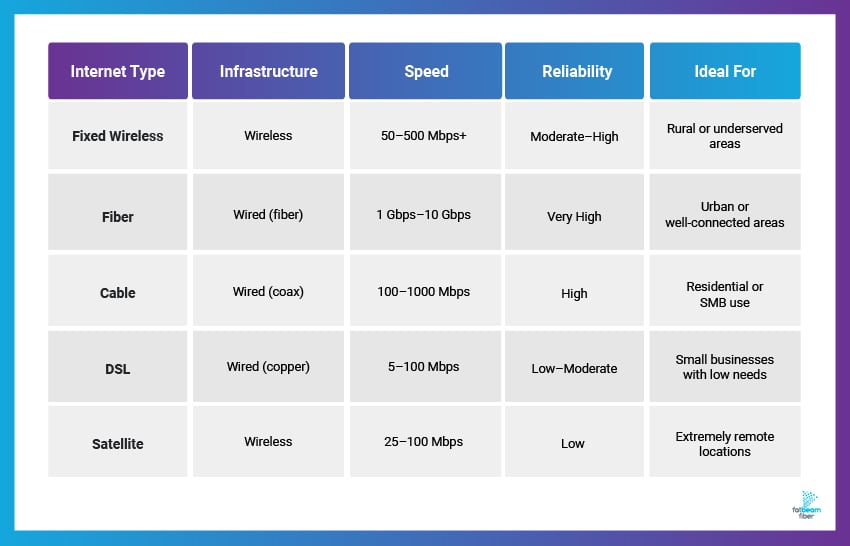
While fixed wireless can’t always match fiber in terms of bandwidth, it outperforms satellite and DSL in speed, reliability, and latency – and is much easier to deploy in rural regions.
How Fast Is Fixed Wireless Broadband?
Speed is usually one of the first questions businesses ask about any internet connection. With modern fixed wireless equipment and optimal conditions, business-class FWA can provide:
- Download speeds of up to 500 Mbps (or more in mmWave 5G deployments)
- Upload speeds of 50–100 Mbps
- Latency as low as 10–30ms (great for video calls and VoIP)
Speeds may vary based on your provider, distance from the tower, and whether your business qualifies for dedicated FWA instead of shared services. At Fatbeam, we engineer our fixed wireless internet options to meet enterprise needs with low oversubscription ratios, dedicated bandwidth availability, and robust SLAs.
Fixed Wireless Limitations: Line of Sight and Weather
Fixed wireless is a strong option for many businesses, but a few real-world factors affect how it performs, and knowing them up front helps you plan the right deployment.
-
Line-of-sight obstructions: Your receiver needs a reasonably clear path to the tower. Trees, tall buildings, and hilly terrain can weaken the signal, though modern equipment tolerates some obstruction and a professional site survey will confirm what your location can support.
-
Weather sensitivity: Heavy rain, snow, and dense fog can attenuate the signal, and the effect is more noticeable on higher-frequency mmWave links than on lower bands. For most well-engineered connections the impact is minor and short-lived, though it is a real consideration for sites in areas with frequent severe weather.
-
Distance from the tower: Performance can taper the farther you are from the base station, which is why links typically run within 5 to 10 miles. Sites closer to the tower generally see stronger, more consistent speeds.
-
Bandwidth ceiling versus fiber: Fixed wireless delivers plenty of capacity for most business workloads, but its peak bandwidth usually sits below top-tier fiber. If you routinely move very large data volumes, fiber may still be the better fit for those specific sites.
None of these rule fixed wireless out. Most are manageable with the right engineering: a dedicated link, a low oversubscription ratio, and a proper site survey address the majority of line-of-sight and reliability concerns, which is why business-grade fixed wireless holds up for mission-critical use.
Top 5 Benefits of Fixed Wireless Internet
Wondering what the benefits of fixed wireless internet are for your business? Here’s what makes it a smart choice:
1. Rapid Deployment
No trenching or construction needed. Businesses can be up and running in days, not weeks.
2. Reliable Backup
Fixed wireless is often used as a failover connection to ensure uptime during fiber outages or disruptions.
3. Cost-Effective
Avoids the high buildout costs of fiber, especially in low-density areas.
4. Scalable Speeds
From basic bandwidth to high-throughput connections, FWA can scale to meet your needs.
5. Secure & Private
Business-grade fixed wireless supports encrypted links and traffic segmentation for security and compliance.
Partner With Fatbeam for High-Performance Fixed Wireless Access
Fixed wireless is a great fit for your business if:
- You’re located in an area without access to fiber or cable.
- You need internet fast and can’t wait for a lengthy install.
- You want redundant connectivity for disaster recovery.
- You operate remote sites or field offices that still need reliable access.
At Fatbeam, we help businesses choose the right connectivity solution with high-speed internet tailored to your needs. Whether you’re running a rural operation, launching a new site, or adding redundancy to your network, our fixed wireless or dedicated internet access services give you the speed and scalability to stay connected.
Let’s talk about how fixed wireless can support your goals. Contact Fatbeam today to get started.
Fixed Wireless Internet FAQs
What is fixed wireless internet?
Fixed wireless internet is a type of business broadband that delivers connectivity over radio signals instead of cables. It creates a dedicated link between a transmission tower and a receiver installed at your location, so it does not need trenching or buried fiber to reach you. That makes it a practical option for rural, suburban, and underserved sites, as well as for businesses that need to get online quickly or add a backup connection. Modern deployments using 5G and mmWave can reach speeds that rival fiber.
How does fixed wireless internet work?
Fixed wireless works by sending your internet connection through the air rather than through a cable. A transmission tower connected to a fiber backhaul beams radio signals to a receiver antenna at your building, usually within 5 to 10 miles. That receiver links to a router, which distributes the connection across your network over Ethernet or Wi-Fi. The link relies on line of sight, meaning the receiver needs a reasonably clear path to the tower. The result is a fast, dedicated connection with no digging or construction.
Is fixed wireless internet good?
For the right situation, yes. Fixed wireless is a strong fit when fiber or cable is unavailable, when you need internet fast, when you run remote or temporary sites, or when you want a backup link for redundancy. It deploys in days, scales as you grow, and supports business tools like VoIP, POS systems, and video calls. It is not always the best choice for sites that move enormous data volumes, where fiber's higher ceiling wins, but for most businesses it delivers reliable, fast connectivity without the cost and wait of trenching.
How fast is fixed wireless internet?
Business-class fixed wireless typically delivers download speeds up to 500 Mbps, and more in mmWave 5G deployments, with upload speeds of 50 to 100 Mbps. Latency usually runs between 10 and 30 milliseconds, which is low enough for smooth video calls and VoIP. Your actual speeds depend on your provider, your distance from the tower, and whether you are on a dedicated connection or a shared one. Dedicated, business-grade service with a low oversubscription ratio delivers the most consistent performance.
Does weather affect fixed wireless internet?
Weather can affect fixed wireless, but usually only modestly. Heavy rain, snow, and dense fog can weaken the signal, and the effect is more noticeable on higher-frequency mmWave links than on lower bands. For most well-engineered connections the impact is minor and short-lived, and a properly installed link with a clear line of sight to the tower stays reliable through typical conditions. If your site sees frequent severe weather, it is worth discussing with your provider so the deployment is designed with that in mind.
Is fixed wireless internet good for gaming?
Fixed wireless is fine for casual gaming and works for many players, since latency typically sits between 10 and 30 milliseconds. Competitive online gaming is more demanding, and factors like line-of-sight conditions and distance from the tower can introduce variability that serious gamers notice. If low, ultra-consistent latency is your priority, wired fiber is generally the stronger choice. For a business that games occasionally or needs solid everyday performance, fixed wireless handles it well.
What is the difference between fixed wireless and mobile wireless?
Fixed wireless connects a single, stationary location, like your office, through a receiver aimed at a specific tower, which gives it a dedicated and consistent link. Mobile wireless, the kind your phone uses, is built to move with you and hands your connection between towers as you travel. Because fixed wireless serves one fixed point with a focused antenna, it can offer steadier speeds and lower congestion for a business site than a mobile connection sharing a tower with everyone passing through.
How far can fixed wireless internet reach from the tower?
Fixed wireless links typically operate within about 5 to 10 miles of the transmission tower, though the exact range depends on your local topography and line of sight. Hills, dense tree cover, and tall buildings between your receiver and the tower can shorten that reach, while a clear, unobstructed path extends it. Sites closer to the tower generally get stronger, more consistent speeds. A site survey is the reliable way to confirm what your specific location can support.
Sources: