Many businesses reach a point where their current internet connection just can’t keep up anymore. Cloud applications feel slower, video calls freeze, and file uploads take longer than they should. That often leads to the same question: What is fiber internet, and why is everyone talking about it?
TL;DR
- Fiber internet is a broadband connection that carries data as pulses of light through ultra-thin glass fibers, delivering far more speed, bandwidth, and reliability than the copper wiring behind cable and DSL.
- Fiber's speeds are symmetrical, so uploads run as fast as downloads, keeping cloud backups, large file transfers, and video calls smooth in both directions, unlike the slower uploads on cable and DSL.
- Business-grade fiber scales from 100 Mbps to 100 Gbps, so the connection can grow with your team without major construction or equipment swaps as your bandwidth needs increase.
- Because fiber uses light rather than electricity, it resists the distance limits, weather, and interference that degrade copper, and it does not slow down during peak hours the way shared cable networks do.
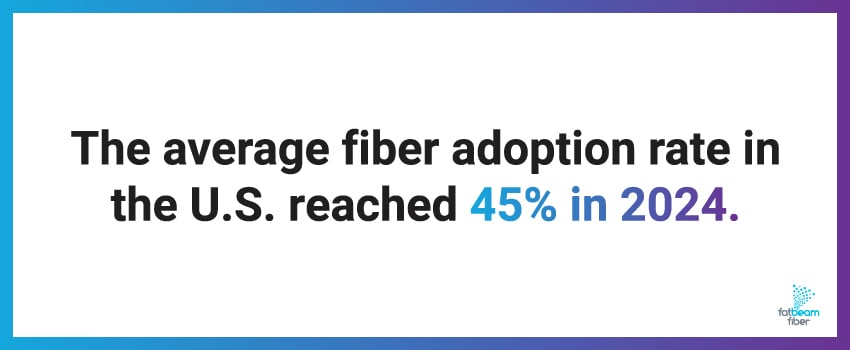
Fiber is quickly becoming the go-to choice in the U.S., with the average adoption rate reaching 45% in 2024.1 But is it the right choice for your business? In this guide, we’ll explain how fiber internet works, how fast it can get, and why so many organizations choose it when they want a connection that supports productivity and growth.
What Is Fiber Internet?
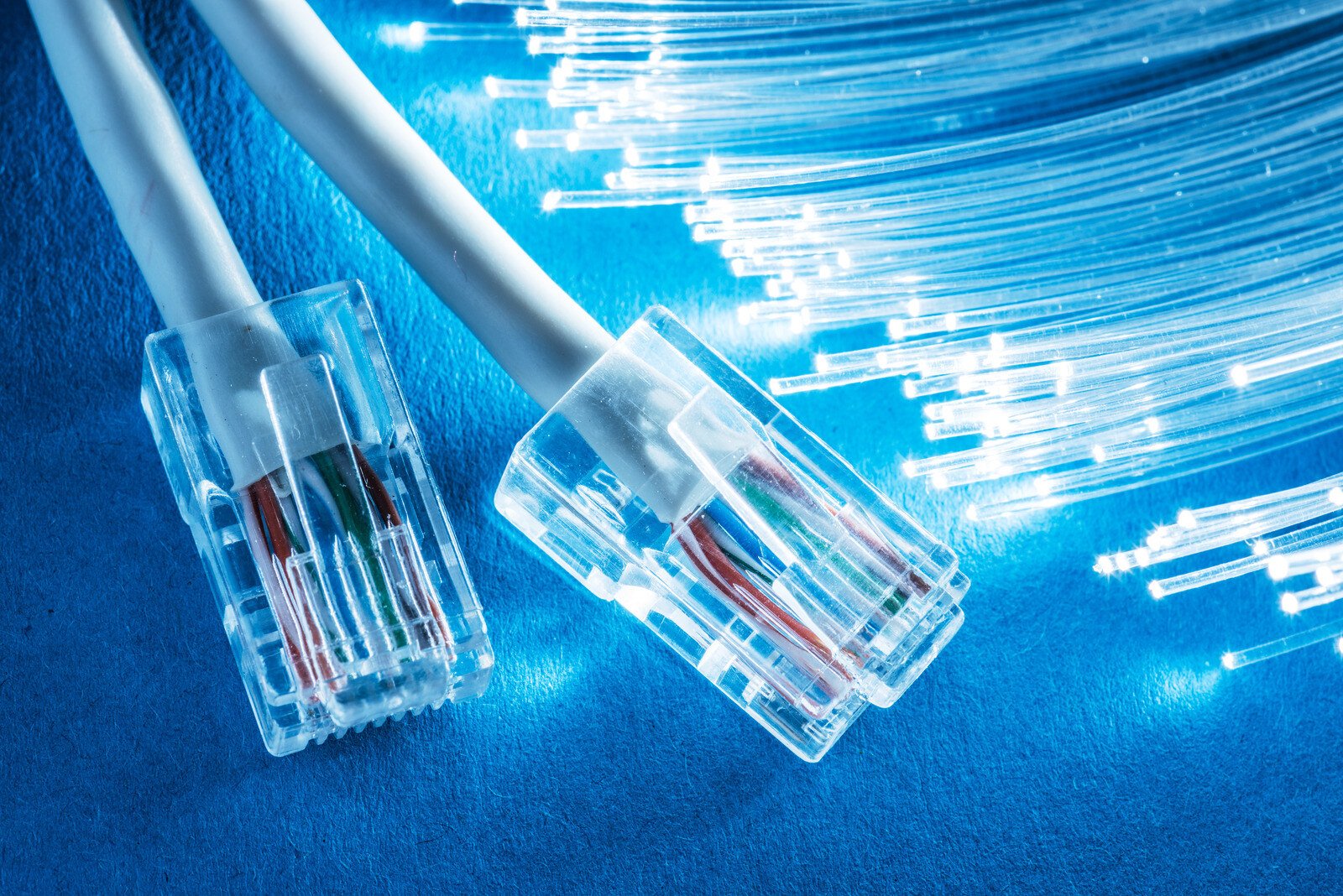
Fiber internet (also known as fiber optic internet) is a type of broadband connection that sends data as light pulses over fiber-optic cables. These cables are made from ultra-thin glass or plastic fibers and can transmit data over long distances without signal degradation.
Traditional cable and DSL internet solutions rely on copper wiring, so they can only send so much data before the signal slows down or gets distorted. Fiber avoids these issues by using light instead of electricity, resulting in a connection that offers a much higher capacity for speed, bandwidth, and reliability.
What Is Fiber Internet Service?
Fiber internet service refers to how the fiber connection reaches your building. Some bring fiber all the way into your home or office, while others switch to copper for the final distance. Here’s a quick breakdown of the different fiber service types:
- FTTH (Fiber to the Home): Fiber runs directly to the premises.
- FTTP (Fiber to the Premises): Similar to FTTH, often used for businesses.
- FTTN (Fiber to the Node): Uses fiber to reach a cabinet near your building and then switches to copper.
- FTTC (Fiber to the Curb): Fiber stops at the curb outside the location before shifting to coax or copper.
At Fatbeam, we focus on bringing fiber service directly to your building, so you can enjoy true fiber performance rather than losing speed on the final stretch of the connection.
How Does Fiber Internet Work?
Let’s break down how fiber internet works behind the scenes:
- Data Is Transmitted as Light: Fiber-optic cables convert your internet traffic into binary data using laser or LED-generated light pulses.
- Signals Travel Through Optical Fibers: The light travels down the core of the fiber cable via total internal reflection, bouncing along the path with minimal loss.
- An ONT Converts the Signal: An Optical Network Terminal (ONT) at your building receives the signal and turns it into a format your router can use.
- Your Network Distributes the Connection: From there, your internal switches, Ethernet cables, and Wi-Fi network give every device access.
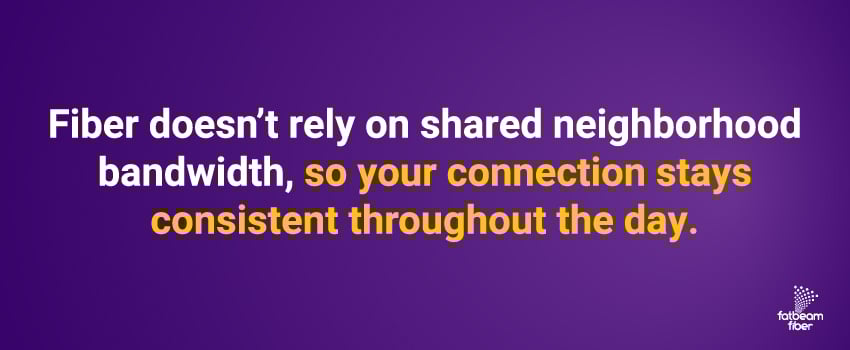
Because fiber doesn’t rely on shared neighborhood bandwidth the way cable networks do, your connection stays consistent throughout the day. Your teams won’t experience the same drop in speed during busy hours or when other businesses nearby are connected.
How Fast Is Fiber Optic Internet?
Speed is one of the top-selling points of fiber – but exactly how fast is fiber internet?
Enterprise-grade fiber internet speeds typically range from 100 Mbps to 10 Gbps or more, but not every business needs to invest in the fastest options.
- 100 to 500 Mbps works well for small offices with basic needs.
- 1 Gbps supports larger teams, cloud apps, and consistent video meetings.
- 10 Gbps and up is common for organizations that transfer large files or run mission-critical systems.
Fatbeam’s scalable fiber solutions start at 100 Mbps and scale all the way up to 100 Gbps to meet the needs of businesses across education, healthcare, government, and commercial sectors.
How Fast Is Fiber Internet Compared To Other Technologies?
It’s easier to see the value of fiber when you line it up next to other options. Each internet type uses different technology, which affects speed, reliability, and how well it supports apps like cloud services, video meetings, and remote access.
Here’s a quick chart to help you compare what you get with the most popular internet options:
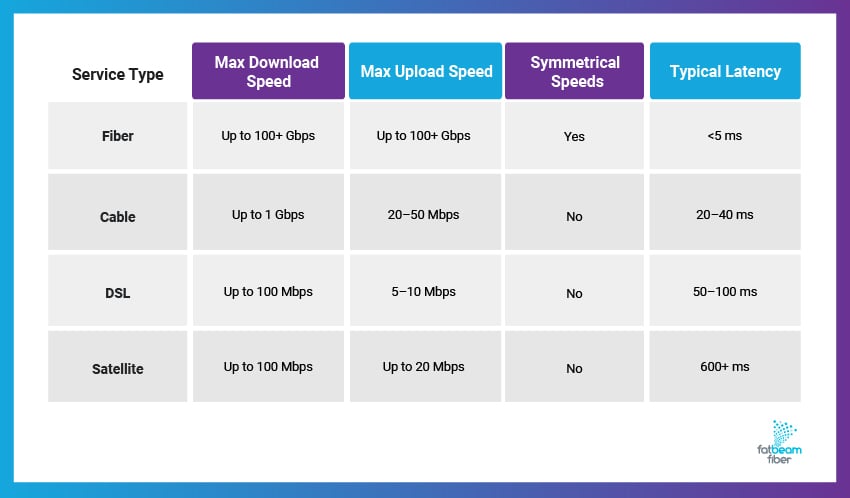
Fiber clearly outpaces the alternatives, not only in overall speed but also in how smoothly it supports real-time communication and cloud tools.
What Are the Benefits of Fiber Optic Internet?
Fiber internet offers several advantages for businesses beyond raw speeds, including:
Increased Productivity
With fiber, employees can access files, cloud tools, and video meetings without buffering or lag. High upload speeds also enable seamless backups, file sharing, and VoIP calls.
Symmetrical Speeds
Fiber gives you equal upload and download speeds, unlike cable and DSL, which leave uploads far slower than downloads. That symmetry is where much of the business value sits: cloud backups finish on schedule, large files move to clients quickly, and VoIP and video calls stay clear in both directions. When your team sends as fast as it receives, slow uploads stop being a bottleneck.
Reliable Connectivity
Fiber cables aren’t affected by distance, weather, or electromagnetic interference in the same way copper lines are, which helps minimize outages and keeps your team connected when it matters most.
Better Performance
Fiber’s naturally low latency improves both voice and video call performance. It also means remote desktops and SaaS apps that need quick response times run more smoothly.
Stronger Security
Fiber is more secure than traditional cables. It’s difficult to tap into without detection, and because the signal is light-based, it doesn’t emit signals that can be intercepted.
Scalable Bandwidth
Fiber grows with your business. Whether you’re opening new locations, hiring more employees, or launching cloud services, fiber makes it easy to scale bandwidth without major construction or equipment upgrades.
Future-Proof Infrastructure
Fiber is the long-term connectivity standard. Bandwidth needs grow with IoT, AI, and hybrid work, but fiber-optic internet helps businesses stay ahead of changing needs.
Make the Switch to Fatbeam Fiber Today
Some organizations move to fiber internet because they don’t want to deal with the ups and downs of cable or DSL anymore. Others make the switch when they open new locations or roll out applications that demand more bandwidth. No matter the reason, fiber offers a reliable foundation to keep your business performing optimally.
Our team at Fatbeam Fiber is here to help you evaluate your options and provide an internet solution that meets your performance and budget needs. We purpose-built our fiber business services to deliver:
- Dedicated connections, not shared bandwidth
- Symmetrical speeds to keep uploads as fast as downloads
- Enterprise SLAs that guarantee uptime and performance
- Customized bandwidth tiers to fit your unique needs
- 24/7 network monitoring and support
As the fastest-growing fiber provider in the West, we’ll help you get started with a fiber internet solution that supports your goals – all with no data caps, no bursting fees, no local loop charge, and zero hidden fees. Contact Fatbeam today.
Fiber Internet FAQs
What is fiber internet?
Fiber internet is a broadband connection that sends data as pulses of light through ultra-thin strands of glass or plastic, instead of the electrical signals copper cable and DSL use. Because light carries far more data with less loss over distance, fiber delivers higher speeds, more bandwidth, and greater reliability than older connection types. It also provides symmetrical speeds, meaning your uploads are as fast as your downloads, which is why so many businesses rely on it for cloud tools, video calls, and large file transfers.
How does fiber optic internet work?
Fiber optic internet works by converting your data into pulses of light generated by a laser or LED. Those light pulses travel down the glass core of the fiber cable by total internal reflection, bouncing along the path with very little loss, and moving at close to the speed of light. When the signal reaches your building, an Optical Network Terminal (ONT) converts the light back into a format your router understands. From there, your switches, Ethernet, and Wi-Fi share the connection with every device.
How fast is fiber internet?
Business-grade fiber typically ranges from 100 Mbps to 10 Gbps or more, and some providers scale to 100 Gbps or beyond. A practical way to think about it: 100 to 500 Mbps suits small offices with basic needs, around 1 Gbps supports larger teams running cloud apps and steady video meetings, and 10 Gbps and up fits organizations moving large files or running mission-critical systems. Fiber speeds are also symmetrical, so those numbers apply to uploads as well as downloads.
Is fiber internet better than cable?
For most businesses, yes. Fiber outperforms cable on the measures that matter: it offers symmetrical speeds where cable uploads are much slower than downloads, it delivers lower latency for smoother video and voice calls, and it does not share bandwidth at the neighborhood level, so your speeds stay consistent during busy hours. Cable can be a reasonable option where fiber is not available, but where you have the choice, fiber gives you more headroom, better reliability, and a connection that scales with your business.
How much does fiber internet cost?
Fiber internet pricing varies widely, so business fiber is usually custom-quoted rather than sold at a flat rate. The main factors are the speed tier you choose, whether fiber already reaches your building or needs to be built out, your location, the contract term, and any service guarantees like an SLA. A small office plan costs far less than a multi-gigabit, mission-critical connection with dedicated bandwidth. The best approach is to get a quote based on your actual usage rather than headcount, so you are not paying for capacity you will not use.
How do you get fiber internet?
Start by checking whether fiber is available at your address, since coverage depends on whether a provider's network reaches your location. If it does, you choose a service type and speed tier, then the provider schedules installation. If fiber has not been built to your building yet, some providers can extend their network to reach you, though that adds time and cost. For a business, it helps to discuss your usage and growth plans with the provider so they can recommend the right speed and connection type.
How is fiber internet installed?
Installation usually begins with running a fiber line from the provider's network to your building, sometimes underground and sometimes aerially. A technician then installs an Optical Network Terminal (ONT), the device that converts the light signal into one your equipment can use, and connects it to your router. From there, your internal network, switches, Ethernet, and Wi-Fi distribute the connection to your devices. Timelines vary: if fiber already reaches your building, setup is quick, but new construction to your site takes longer.
Is fiber internet wireless?
No, fiber internet is a wired connection. Your data travels as light through physical fiber-optic cables running from the provider's network to your building, which is exactly what makes it so fast and reliable. The wireless part happens only inside your building: once fiber delivers the connection to your router, that router can broadcast Wi-Fi to your devices. So while you can use fiber over Wi-Fi, the fiber connection itself is not wireless, and the wired link is what carries the speed.
Sources: