Running your own data center sounds appealing until you realize the reality. You're responsible for building and maintaining the physical facility, managing power systems, ensuring cooling works perfectly, upgrading security constantly, and handling all the regulatory compliance requirements. It's a massive undertaking that pulls resources away from your actual business.
That's why data center colocation exists. Instead of carrying that burden alone, you can partner with a specialized provider who handles all the infrastructure complexity while you maintain control of your own servers and equipment. The colocation market is projected to nearly double over the next few years – from $104 billion in 2025 to $204 billion by 2030.1
But what is a colocation data center, and how can it help your business grow? This guide walks you through everything you need to know.
TL;DR
- A colocation data center lets businesses house their own servers and networking equipment in a third-party facility while the provider manages power, cooling, connectivity, and physical security.
- Retail, wholesale, and hybrid colocation serve different infrastructure needs, offering a middle ground between fully managed cloud services and running an on-premises data center.
- Colocation can reduce upfront infrastructure costs while improving reliability, scalability, connectivity, physical security, and support for compliance requirements.
- When choosing a facility, consider location, carrier-neutral connectivity, security, redundancy, support, power capacity, and whether it can accommodate future high-density and hybrid-cloud workloads.
What Is a Colocation Data Center?
A colocation data center, or “colo” for short, is a third-party facility where businesses can rent space to house their servers, networking gear, and other hardware. Rather than maintaining your own server room or data center, you colocate your equipment in a secure, professionally managed environment.
Colocation is the practice of placing your physical IT infrastructure – like servers, firewalls, and storage systems – in a facility owned and operated by a data center provider. You retain control of your equipment, while the provider manages the building, power, cooling, bandwidth, and physical security.
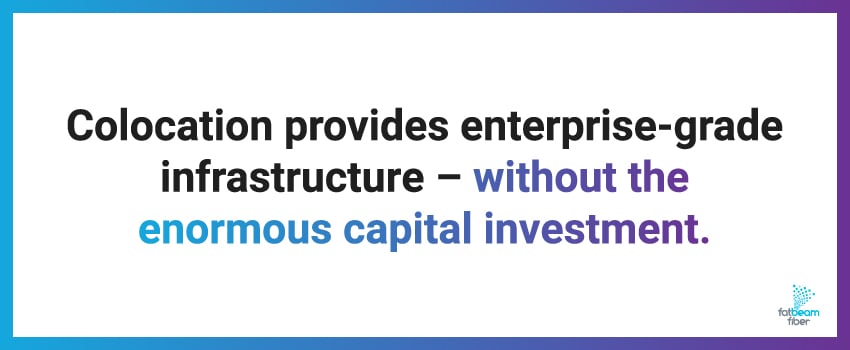
This model lets you get enterprise-grade infrastructure without the enormous capital investment and operational headache of building it yourself.
What Is a Colocation Facility?
A colocation facility is a purpose-built data center designed to host multiple tenants' IT equipment in separate, secure spaces. These facilities are built with:
- Redundant power systems (UPS, generators, dual power feeds)
- Precision cooling and climate control
- High-speed, carrier-neutral network connectivity
- 24/7 monitoring and security
- Fire suppression and disaster recovery systems
When you colocate, your business rents a portion of the space – either by the rack, cabinet, cage, or even a suite – depending on how much infrastructure you have. Not sure how much space you’d need? Our experts at Fatbeam Fiber can help.
Types of Colocation: Retail, Wholesale, Hybrid
Colocation is not one-size-fits-all. Providers package space in a few different ways, and the right one depends on how much infrastructure you're running and how much of the management you want to hand off.
Retail Colocation
Retail colocation is the most common option. You lease a smaller footprint inside a shared facility, typically a few rack units, a full rack, or a private cage. It suits businesses that need enterprise-grade power, cooling, and security without committing to large amounts of space. Because you share the facility with other tenants, you also share the cost of the infrastructure around your equipment.
Wholesale Colocation
Wholesale colocation is built for scale. Instead of a rack or a cage, you lease a large dedicated space, such as a data hall or a private suite, often with a committed power capacity measured in kilowatts or megawatts. The per-unit rate is usually lower than retail, which makes it a fit for large enterprises and organizations running heavy or fast-growing infrastructure.
Hybrid Colocation
Hybrid colocation blends physical colocation with cloud connectivity. You keep your own hardware in the facility while linking directly to public cloud platforms through the provider's network. This model works well if you want to keep sensitive or performance-critical systems on your own equipment while still tapping cloud services for the workloads that benefit from them.
Some providers also offer managed colocation, where day-to-day equipment monitoring and maintenance are handled for you as an add-on rather than left to your team.
How Does Colocation Compare To Other Models?
Understanding colocation means understanding how it fits differently from other approaches to infrastructure.
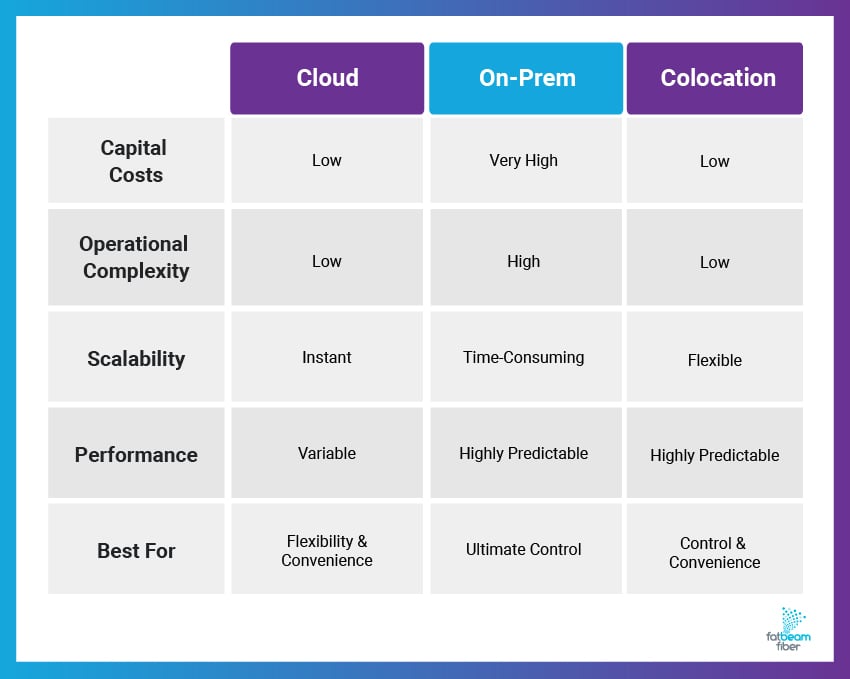
Cloud services offer convenience and flexibility. You hand everything over to a cloud provider who manages all the infrastructure and scales instantly. The tradeoff is less control. If you need complete control over your environment, the cloud might feel restrictive.
On-prem data centers give you ultimate control. You own everything, but that means you're responsible for building the facility, managing power and cooling, handling physical security, upgrading infrastructure, and dealing with all the operational complexity. It's powerful but expensive and demanding.
Colocation strikes a balance between control and convenience – making it a popular option for businesses that have outgrown their server rooms but don’t want to move everything to the cloud.
6 Benefits of Colocation Data Centers
If you’re wondering about the benefits of colocation data centers, here are the top advantages for business customers:
1. Cost Efficiency
Building your own data center is expensive. Colocation lets you avoid capital expenses (CapEx) by shifting to an operational model (OpEx). You only pay for the space and services you need, and you can scale up or down as your business changes.
2. Enhanced Reliability
Colocation data centers are purpose-built for reliability in ways that most companies can't replicate on their own. They offer redundant power feeds, climate control, and diverse network paths to provide maximum resilience for your systems.
3. Scalable Infrastructure
Need to add more servers or expand to a full rack? Colocation makes it easy to scale without needing to construct additional infrastructure.
4. High-Speed Connectivity
Many colocation data center designs are carrier-neutral, offering access to multiple ISPs and direct fiber connections. This means better performance and redundancy for your business.
5. Strong Physical Security
Colocation providers build strong physical security into their facilities, such as biometric access controls, surveillance systems, security guards, and access logs.
6. Support for Compliance
If your business must meet regulatory standards (HIPAA, PCI, etc.), colocation helps by providing secure, controlled environments with documented procedures. At Fatbeam, we work with your team to ensure your specific compliance requirements are met.
How Much Does Colocation Cost? Pricing Factors
Colocation pricing is rarely a single sticker price. Most providers quote based on how much space and power you need, so the total depends on your specific deployment. A few factors drive what you'll pay:
- Space: whether you rent by the rack unit, full rack, cage, or private suite. More space means a higher base cost.
- Power: power is often the biggest line item. Providers price by the amount of power you draw, measured in kilowatts, and higher-density setups cost more to power and cool.
- Bandwidth and connectivity: the amount of bandwidth you commit to, plus any cross-connects to carriers or cloud platforms, adds to the monthly total.
- Redundancy level: facilities with higher power and cooling redundancy (such as 2N over N+1) generally command a premium for the added resilience.
- Support services: remote hands, extra monitoring, and managed add-ons are usually billed on top of the base rate.
Colocation shifts most of these costs from a large upfront capital investment (CapEx) to a predictable monthly operating expense (OpEx). Because every deployment is different, ask for a tailored quote rather than relying on published rates. Have your space, power, and connectivity requirements ready, and a provider can size the cost to what you actually need.
Colocation Data Center Examples
Still not sure how data center colocation can work for your business? Here are a few colocation data center examples:
- Regional Healthcare Provider: Needs HIPAA-compliant infrastructure with redundant power and security. Colocation provides a secure, cost-effective alternative to building out its own Tier III environment.
- Financial Firm: Requires low-latency connectivity to major carriers and data centers. Carrier-neutral colocation provides the ideal environment with multiple redundant paths.
- E-commerce Company: Wants full control over its servers for performance optimization but doesn’t want to worry about physical infrastructure. Colocation offers the flexibility and control they need.
Each of these examples shows how colocation provides different benefits depending on the business situation.
Who Should Use Colocation?
Colocation makes sense if your organization:
- Is growing beyond the capacity of on-site server rooms
- Needs reliable, secure environments for sensitive workloads
- Requires predictable performance and latency
- Must meet strict compliance or security standards
- Wants to retain hardware control while outsourcing facility management
If your business values performance, uptime, and cost control, colocation is absolutely worth exploring.
Challenges and Drawbacks of Colocation Centers
Colocation solves a lot of problems, but it isn't the right fit for everyone. Knowing the trade-offs upfront helps you decide whether it matches your situation.
- You still manage your hardware: colocation removes the facility burden, not the equipment one. Your team is still responsible for your servers, software, and configurations unless you pay for managed services.
- Scaling takes planning: adding physical capacity is not as instant as spinning up cloud resources. Growth means reserving more space and power ahead of time, so capacity planning matters.
- Location is a commitment: once your equipment is installed, moving it is disruptive. Choosing a facility in the wrong region, or one exposed to natural-disaster risk, is costly to undo.
- Shared security responsibility: the provider secures the building, but protecting your own systems from cyber threats stays on you. A shared facility does not replace your own security controls.
- Not always worth it for the smallest teams: very small businesses with light infrastructure may find a fully cloud-based setup simpler and cheaper than maintaining hardware in a colocation facility.
What To Look for in a Colocation Data Center
When evaluating providers, consider the following:
Location
How close is the facility to your headquarters or your team? Its proximity to your team or HQ can simplify maintenance and reduce latency.
Connectivity
Carrier-neutral facilities let you connect to multiple internet providers so that you're not locked into one carrier's prices or service quality. Working with the right data center provider can also give you access to a hybrid cloud infrastructure for more flexibility.
Security
The facility’s data center security measures should be documented and appropriate to your sensitivity level. Look at access controls, surveillance coverage, and security procedures, and ensure the physical security matches your requirements and regulatory obligations.
Redundancy
Look for at least N+1 redundancy in power systems, meaning your systems stay online even if one power system fails. Better providers offer 2N redundancy for even greater resilience.
Support
When you have a crisis with your infrastructure, responsive support makes all the difference. Consider whether remote hands services or on-site support are available when you need them. At Fatbeam, our Network Operations Center staff is here 24/7 to keep you online.
Colocation Trends: AI and High-Density Demand
Demand for colocation has climbed sharply, and the biggest driver is the compute behind artificial intelligence. AI and other data-heavy workloads pack far more power into each rack than traditional servers, and that shift is reshaping what businesses look for in a facility.
- AI and high-density workloads: GPU-heavy AI and machine learning systems draw far more power per rack than older equipment, so facilities are being built for higher power density and more advanced cooling.
- Hybrid and multicloud strategies: more businesses run workloads across their own hardware and several clouds at once. Colocation sits in the middle, offering direct connections to major cloud platforms.
- Edge computing: pushing processing closer to users cuts latency, which is driving demand for colocation in more regional markets rather than only in a handful of large hubs.
- Sustainability: power use and efficiency are now part of the buying decision, and providers are investing in more efficient cooling and cleaner energy to meet it.
For most businesses, the practical takeaway is to choose a facility that can handle rising power density and connect cleanly to the clouds and carriers you rely on, not just one that meets today's needs.
Get Started With Fatbeam’s Colocation Data Center Solutions
Colocation offers a smart way to future-proof your infrastructure while controlling costs and maintaining control. Now that you know what a colocation data center is, how it works, and the benefits of colocation data centers, you can make a more informed decision for your business.
At Fatbeam, we deliver colocation data center services designed for businesses that need secure, high-performance infrastructure – without the overhead of managing it all in-house.
We offer:
- Multiple colocation data center design options, including racks, cages, and private suites
- Redundant power and cooling to maximize uptime
- Direct access to our private fiber network and multiple Tier 1 carriers
- 24/7 monitoring and support
- Scalable configurations to meet your future growth
Whether you need a small footprint or a custom deployment, we help you colocate with confidence.
If you’re looking for secure, scalable data center colocation in your region, we’re here to help. Contact us today to learn how Fatbeam can support your business infrastructure goals.
Frequently Asked Questions
What is a colocation data center?
A colocation data center is a third-party facility where you rent space to house your own servers and networking equipment. You keep ownership and control of the hardware, while the provider supplies the building, power, cooling, bandwidth, and physical security. It gives you enterprise-grade infrastructure without the cost and effort of building and running a data center yourself. Space is usually rented by the rack, cabinet, cage, or private suite, depending on how much equipment you need to house.
What are the main types of colocation?
The three main types are retail, wholesale, and hybrid colocation. Retail colocation means leasing a smaller footprint, such as a rack or a cage, inside a shared facility, and it's the most common choice. Wholesale colocation means leasing a large dedicated space, like a data hall or suite, usually at a lower per-unit rate for organizations with heavy infrastructure. Hybrid colocation combines your own physical equipment with direct connections to public cloud platforms. Some providers also offer managed colocation, where they handle day-to-day equipment management for you.
How much does colocation cost?
Colocation cost depends on your deployment, so most providers give a tailored quote rather than a fixed price. The main factors are how much space you rent (rack, cage, or suite), how much power you draw, your bandwidth and connectivity needs, the level of redundancy you require, and any support services like remote hands. Power is often the largest part of the bill, especially for high-density setups. Colocation typically turns a large upfront capital cost into a predictable monthly operating expense.
What is the difference between colocation and hyperscale?
Colocation and hyperscale both involve large data center facilities, but they serve different needs. In colocation, many different businesses rent space in a shared facility to house their own equipment. A hyperscale data center is a massive facility, usually run by a single large cloud or technology company, built to power its own services at enormous scale. Put simply, colocation is a shared facility you rent space in, while hyperscale is purpose-built infrastructure operated by one organization for its own workloads.
What's the difference between colocation and managed hosting?
With colocation, you own your servers and equipment and simply rent secure space, power, and connectivity to house them. With managed hosting, the provider owns the hardware and rents it to you, and usually manages the operating system, updates, and maintenance too. Colocation gives you more control over your own equipment, while managed hosting hands off more of the day-to-day responsibility. Some colocation providers also offer managed add-ons, which blend the two by handling parts of the management on hardware you own.
What are remote hands services in a colocation facility?
Remote hands are on-site technicians at the colocation facility who handle physical tasks on your equipment when your team can't be there. That can include simple jobs like rebooting a server, swapping a cable, or checking a status light, as well as more involved work like installing hardware or troubleshooting. Because the facility is staffed around the clock, remote hands let you resolve physical issues quickly without traveling to the site. The service is usually billed on top of your base colocation cost.
What compliance standards do colocation data centers meet?
Colocation providers often support a range of regulatory and industry standards, which is one reason regulated businesses use them. Common ones include HIPAA for healthcare data, PCI DSS for payment card information, SOC 2 for security controls, and ISO 27001 for information security management. A colocation facility helps you meet these requirements by providing secure, controlled environments with documented procedures and regular audits. Confirm which specific certifications a provider holds and make sure they match your own compliance obligations.
What is a carrier-neutral colocation data center?
A carrier-neutral colocation data center lets you connect to multiple internet and network providers rather than being locked into one. Because several carriers operate inside the facility, you can choose among them, mix providers for redundancy, and negotiate on price and service quality. This usually means better performance, more reliable connectivity through diverse network paths, and fewer restrictions as your needs change. Carrier neutrality is a key thing to check when comparing facilities, especially if low latency and uptime matter to your business.
Sources: